From Seeing More to Managing Smarter
Keone Dodd, Technical Director, AQ1 Systems
June 15, 2026
How AQ1's SONIC 26.06 system release advances the way farms see, understand, and act on their data?
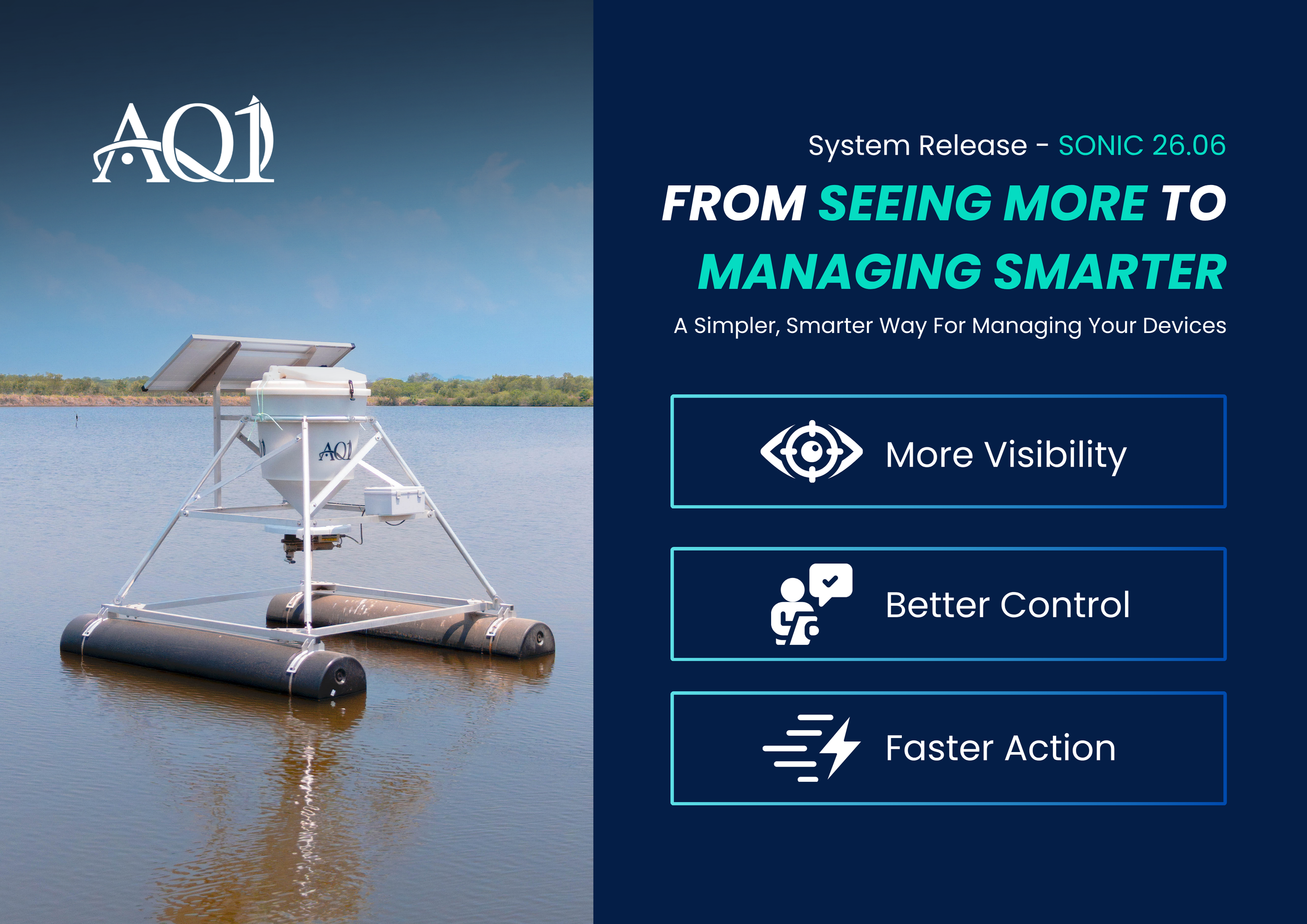
SONIC 26.06 strengthens AQ1 sonic feeding ecosystem by delivering integrated improvements across feeders, hydrophones, sensors, and AQ1 Analytics. Designed for large-scale shrimp farming operations, this release helps connect farm managers, control room operators, technicians, and pond-side teams through greater visibility, control, and data consistency. By aligning hardware, firmware, and software enhancements, SONIC 26.06 reduces operational gaps, improves decision-making, and enables more effective feeding management. The result is a more connected aquaculture operation, better feed optimisation, enhanced farm performance, and greater value from technology investments across the entire precision feeding workflow.
More than a software update!
SONIC 26.06 is a deliberate step in a longer journey. The shift to system-wide releases, the progression toward a consistent navigation model, the move to make internal diagnostic tools available to customers: these are not independent decisions. They reflect a connected view of what aquaculture technology should do: reduce complexity, build trust in data, and give the people running farms more of the information they need, in the place where they actually work.
Seeing more has always been the first step. The farms that make the most of their data are the ones that can move quickly from observation to action, because the information they need is accessible, accurate, and organised around how they actually think about their farm. That is what managing smarter means. And that is what we are building toward.
Progress in aquaculture technology has often followed a familiar pattern: a new sensor here, a firmware update there, a software feature quietly released between seasons. Useful and incremental but rarely coordinated in a way that lets farmers experience the full benefit at once. At AQ1, we have been thinking carefully about whether that approach still serves our customers well as farms grow in scale and complexity. The answer we have arrived at is that it does not.
Starting in 2026, AQ1 has moved to a fixed-date, system-wide release cycle, aiming for three major releases a year, bringing firmware, software, and the customer experience together into a single coordinated release. SONIC 26.06 release is the first full expression of that approach. Under the theme of seeing more and managing smarter, it delivers two headline capabilities (device visibility and salinity management) alongside a foundational shift in how Analytics organises the farm, representing a change in how we think about what the software should do for the people running it.
A shift in how we release
Shrimp farming at scale is an exercise in coordination. Control room operators, pond-side teams, maintenance staff, and farm managers are all working from the same physical reality but often from very different information. When the technology that supports them evolves in fragmented steps (a software fix here, a new device capability there), it creates gaps. Staff adapt, workarounds develop, and the full value of the investment is never quite realised.
SONIC 26.06 is deliberately focused in scope. This is intentional. In a shorter development cycle, tight scope means confident delivery. The two headline features we are releasing are not the most technically complex things we have ever built, but they address pain points that customers raise with us constantly, and they lay the groundwork for more ambitious capabilities in releases to come.
Our commitment with each release is a measurable improvement in on-site performance, across the sonic feeding ecosystem — feeders, hydrophones, and the sensors that inform feeding decisions. And because the value of those improvements is only fully realised when operators can see them, interact with them, and act on them, every hardware and firmware change is paired with the Analytics visibility and control to match.
Seeing your devices where they actually are
Every wireless device AQ1 provides, including Enviros, Smart hydrophones, and feeders, carries GPS. That location data has existed for years. Until now, it has largely stayed invisible to the farm. Customers wanting to confirm a device's last known position, check whether it had been moved, or understand why connectivity had degraded had two options: call AQ1 Support, or make the trip to the pond themselves.
Neither is a good answer for a farm operating at scale. When a disconnected device alarm fires at 2am, the control room operator needs to be able to assess the situation from their screen, not dispatch someone to the pond on the basis of incomplete information. When a device is showing weak connectivity, the first question is usually location-related: has it been moved? Is it too far from the controller? Is there a new obstruction in the signal path? Without a map, answering those questions takes time and guesswork.
SONIC 26.06 makes device location customer-facing in Analytics for the first time. The Device Map shows each wireless device's last known position with a timestamp, so operators can see immediately whether a device is where it should be. Alongside the map, diagnostic trend views show recent signal strength, battery voltage, and current draw. These are the vitals that matter most when trying to understand why a device is behaving unexpectedly.
The practical impact of this is significant. Farms that currently rely on AQ1 Support to interpret connectivity issues will be able to self-serve the majority of those investigations. Work instructions to pond-side teams become more precise: instead of "go check the Enviro on pond 12", operators can say "the Enviro on pond 12 was last seen near the outlet, and its signal has been declining for three days". That context changes the quality of the work.
This capability has been running internally at AQ1 as part of our Support tooling since 2025. The feedback from that experience is what gave us confidence to make it customer-facing. The data was always there; it just needed to be put in the right hands.
Managing salinity from the control room
Dissolved oxygen is one of the key measurements in shrimp farming. Many things depend on DO, including aeration decisions, feeding triggers, and warning alarms, and they rely on the sensor reading it accurately. And accurate DO readings depend on correct salinity in the Enviro probe.
This is well understood by farm managers. What is less well understood, until you have experienced it, is how difficult it is to manage salinity recalibration at scale after a weather event. Heavy rainfall can drop salinity across an entire farm in a matter of hours. When that happens, every Enviro probe needs its salinity adjusted and then adjusted again as salinity returns to normal over the following days. Until now, doing that required staff to travel to each pond individually, connect to the Enviro through a temporary Wi-Fi link, and make the adjustment on-site. On a farm with up to hundreds of ponds, that is a significant amount of labour, and it is labour that occurs at exactly the moment when the team is already under pressure from the weather event itself.
SONIC 26.06 removes that constraint. Enviro salinity settings, and other key Enviro settings, can now be configured directly from Analytics, without a pond visit. The underlying firmware capability to support this has been in development for some time; what the SONIC 26.06 does is surface it as a complete, intuitive workflow in the control room interface.
There is more to come from this feature: Group Apply will allow operators to update salinity across multiple ponds simultaneously, a farm-wide recalibration in minutes rather than hours. This is the kind of operational leverage that genuinely changes how farms respond to environmental events. It also establishes the Analytics-based workflow for Enviro configuration that will become increasingly important as we move toward the planned new Enviro platform in 2027.
The foundation: Farm → Pond → Zone → Device
Both headline features are made possible, and made intuitive, by a supporting change to how Analytics is structured. Historically, the software has organised device access around the controller: to find an Enviro or SM1, an operator had to navigate into controller settings, away from the operational view of the farm. This creates friction. The control room team lives in Pond Control. That is where alarms surface, where feeding schedules are managed, where the farm's operational picture is visible. Device actions that require switching to a different part of the interface slow people down and increase the risk of mistakes.
SONIC 26.06 begins the transition to a consistent Farm → Pond → Zone → Device model in Analytics. Pond Control now surfaces all wireless devices attached to a zone, including feeders, Enviros, and SM1s, in one place. From there, operators can access device maps, view diagnostic trends, and adjust settings without leaving the operational context they work in every day.
This change matters not just for the features it enables today, but for the pattern it establishes. As we add new device types and new capabilities in future releases, the pond-and-zone model provides a consistent home for them. Operators learn it once and it applies everywhere, which reduces training overhead and makes the system more resilient as it grows.
Frequently Asked Questions
-
SONIC 26.06 provides improved visibility, control, and usability across the Sonic Feeding Ecosystem, helping operators make faster and more informed feeding decisions.
-
SONIC 26.06 is designed for shrimp farms operating AQ1's Sonic Feeding System. The release includes updates that work across the broader feeding ecosystem, connecting feeders, hydrophones, sensors, and AQ1 Analytics to provide a more unified user experience.
👉 Learn more about the AQ1 Sonic Feeding System.
-
To access all SONIC 26.06 features and enhancements, connected devices should be updated to the recommended firmware version listed below:
Enviro v1.5, SF200 v7.10, SD100V1 v1.14, SD100V2 v1.4, SM1 v1.2, WAC v1.0
-
To access the latest Sonic 26.06 functionality and visibility improvements, users should ensure they are running the AQ1 Analytics 3.5
-
Yes. Existing customers can contact their local AQ1 Service Team to discuss upgrade options, compatibility requirements, and implementation support.
-
AQ1 customers can contact their local AQ1 Service Team for assistance with Sonic 26.06. Whether you're planning an upgrade or looking to better understand the latest features, we're here to support your farm's success.
-
The AQ1 Sonic Feeding System is a complete shrimp feeding solution that combines intelligent feeders, hydrophones, sensors, advanced algorithms, and AQ1 Analytics to support data-driven feeding decisions. Developed in 2012 as the world's first sensor-based feeding system for shrimp aquaculture, it is now used by farmers to feed more than 1,000,000 tonnes of shrimp annually. Powered by Artificial Intelligence and Machine Learning, the system continuously monitors shrimp feeding activity and adjusts feeding in real time, helping farmers optimise feed efficiency, reduce waste, and focus on feeding the animal rather than the pond.
Other Articles & Expert Insights
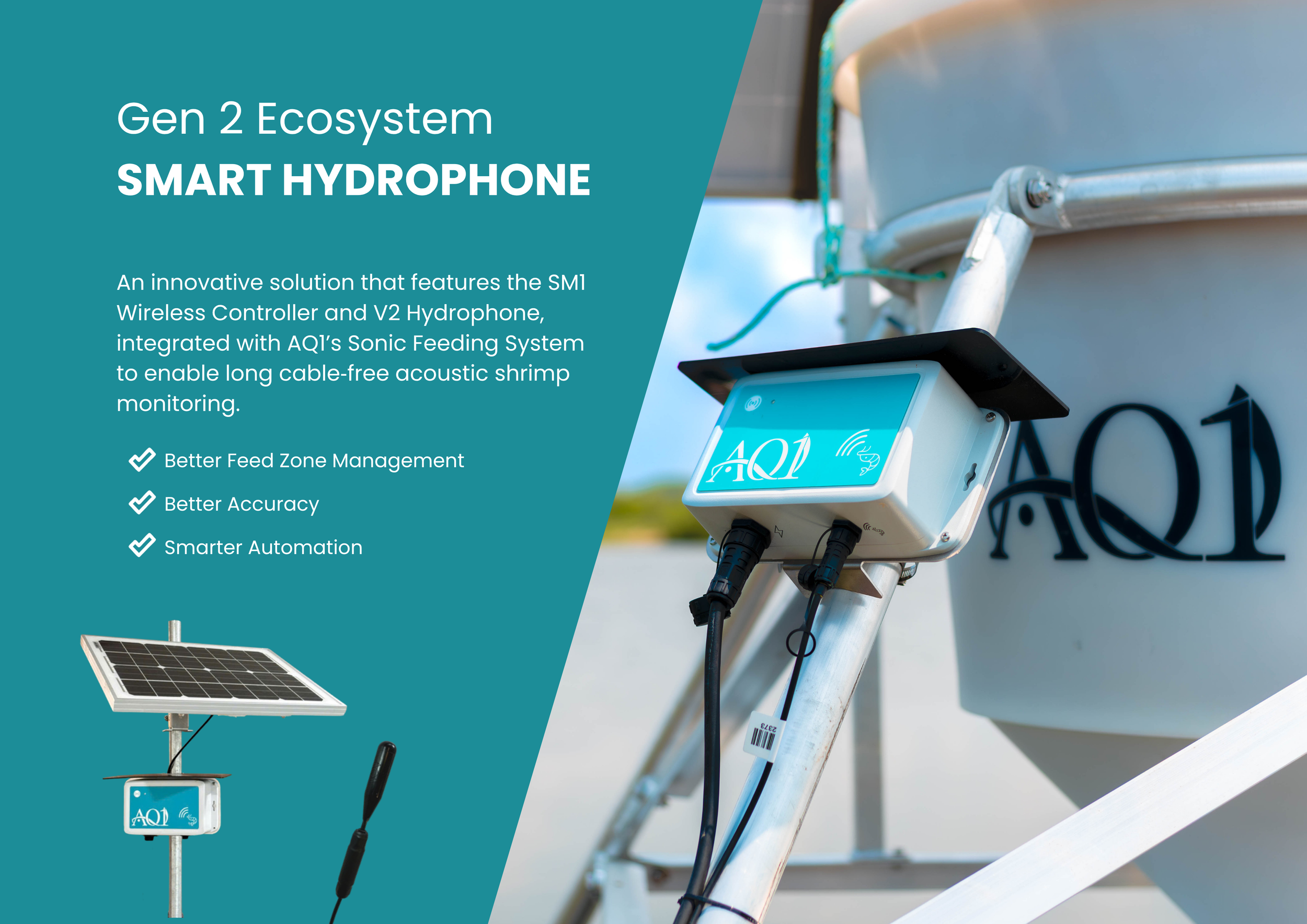
Unlocking the Value of Multiple Feeding Zones
At AQ1, innovation begins with listening. Our journey to multi-zone feeding has been shaped by years of listening - to shrimp, to farmers, and to the realities of pond dynamics…
15/10/2025
Our Technology
About us
Legal
Contact us