Feeding Under Pressure
Managing Ponds Through El Niño
Keone Dodd, Technical Director, AQ1 Systems
15 October 2026
Feeding Under Pressure
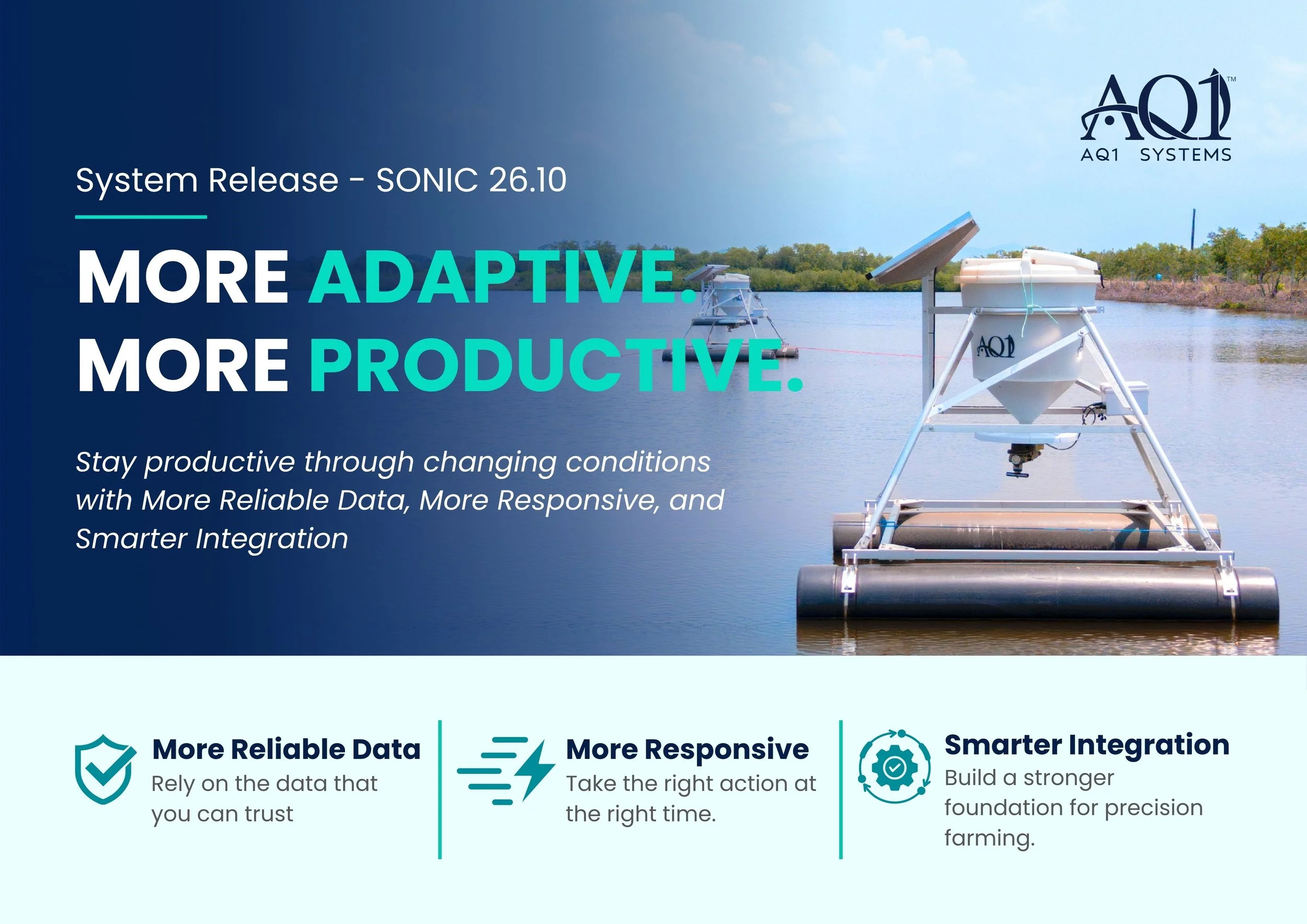
Oxygen, nutrient load and how SONIC 26.10 helps farmers manage a finer margin for error.
….
….
…..
Growing more, faster
Shrimp farming has never produced so much, so quickly. Higher stocking densities and fast-growth genetics have lifted what a single pond can deliver in one crop. That growth has a cost that is easy to overlook. To realise it, farms feed more, and they feed it in a shorter time.
Every kilogram of feed adds nutrients to the pond. Some of it becomes shrimp. The rest becomes waste, ammonia, organic matter and fuel for algae. A pond that is fed harder carries a higher nutrient load, and that load demands oxygen: for the shrimp, for the bacteria that break down waste, and for the algae at night.
In practice, oxygen becomes the limit on how much a pond can be fed. A farm can have the genetics, the stocking density and the feed, but if the water cannot support the demand, the shrimp will not eat to their potential. That is the reality we see on farms every day, and it is the challenge we focused on in SONIC 26.10, the latest AQ1 system release.
Key Finding: More feed in less time means a higher nutrient load, a higher oxygen demand and a much finer margin for error.
Where the margin disappears
In Ecuador, that margin is about to be tested. A very strong El Niño is already under way. In September, the US National Oceanic and Atmospheric Administration gave a greater than 90% chance that it stays very strong through late 2026 and into 2027. For coastal farms, that usually means heavier rain, warmer water and sudden drops in salinity.
These changes do not arrive one at a time. They stack on top of the load that higher-demand systems already put on the pond:
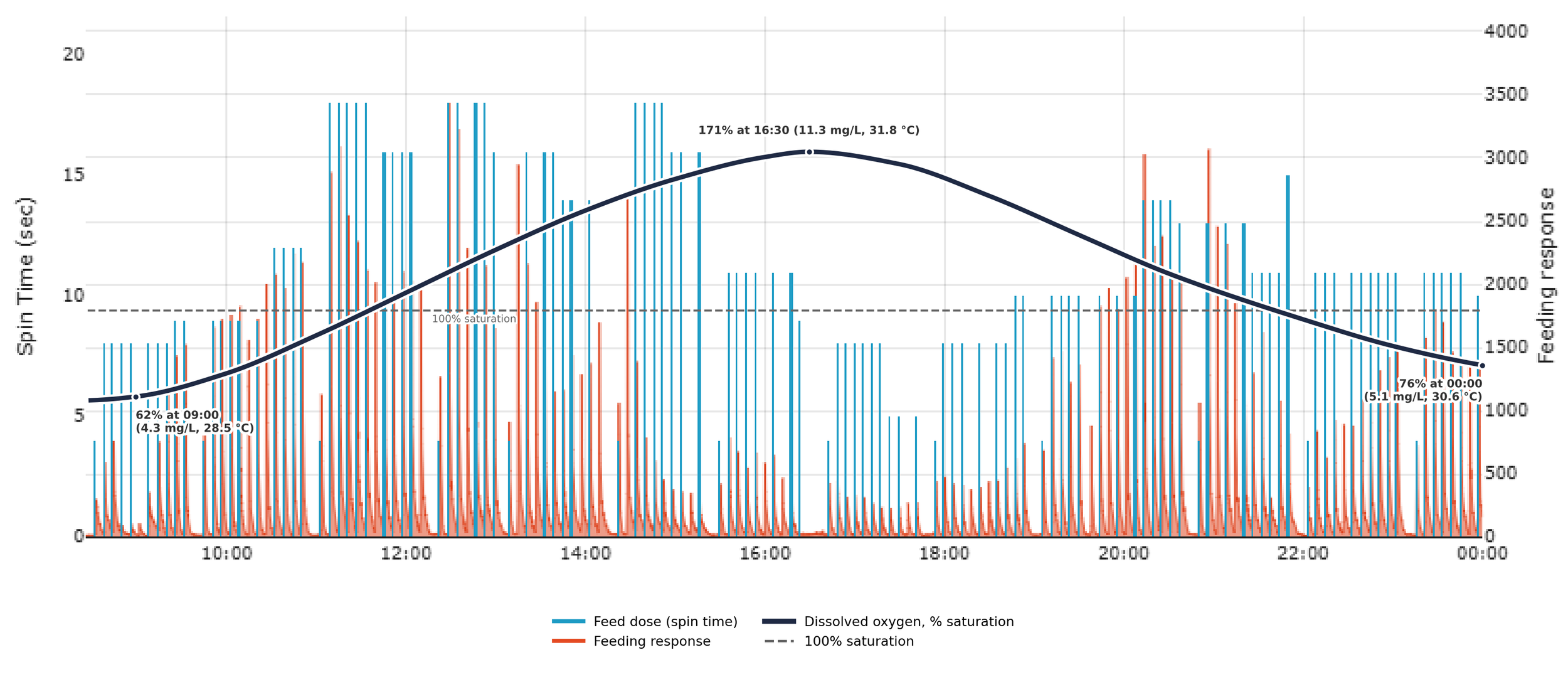
• Algal blooms. A pond rich in nutrients grows algae fast. In the afternoon, photosynthesis can push oxygen well above 100% saturation. Before dawn, the same algae use oxygen, and levels fall.
• Changes in behaviour. Shrimp eat less when oxygen is low, and they also eat less during supersaturation. Feed offered at the wrong time is feed wasted, and waste adds to the load.
• Rain events. Heavy rain cools and freshens the surface, can crash an algal bloom and can drop oxygen quickly.
• Less forgiving genetics. Fast-growth lines need to eat to their potential. Underfeeding costs growth, and it costs resilience. Underfed shrimp are less hardy and less able to cope with the next change in the pond.
When several of these happen at once, the result can be worse than a slow week of growth. At its worst, any combination of these stresses can lead to mass mortality.
Understanding oxygen from the shrimp's point of view
Most farms measure dissolved oxygen in milligrams per litre. That number matters, but it does not show the whole picture. The same reading of 4.0 mg/L can mean something very different for the shrimp, depending on water temperature and salinity.
From the shrimp's point of view, every variation in the pond's conditions is a stressor. Low oxygen before dawn, supersaturation in the afternoon, a sudden drop in salinity after rain, a jump in water temperature. Each one changes how the shrimp behave, and the first thing to change is feeding. Shrimp under stress eat less, and they eat less predictably. A feeding plan built on yesterday's conditions no longer matches the pond.
Percentage saturation brings that stress into view. It shows how close the pond is to its limits in both directions, and when oxygen has gone past 100%. It explains why shrimp have stopped feeding on a bright afternoon when the mg/L reading looks healthy.
SONIC 26.10 brings this view into AQ1 Analytics, which now shows DO % saturation (DOSat) alongside oxygen in mg/L and temperature. Each farm sets its own DOSat thresholds, and colour indicators show at a glance when a pond is too low or too high.
What an adaptive feeding solution needs to do
When the margin is this fine, the systems around the pond have to carry more of the work. A feeding solution built for these higher-demand systems should do five things.
1. Feeding that adapts
Feed rates should respond to shrimp behaviour, and to oxygen, temperature and rain, not to a fixed timer. AQ1 sonic feeding does this by listening to the shrimp and adjusting feed to how they are eating. From SONIC 26.10, every change to the Feeding Strategy is also recorded, so the farm can see when feeding was adjusted for rain or low oxygen.
2. Sensors that are easy to maintain
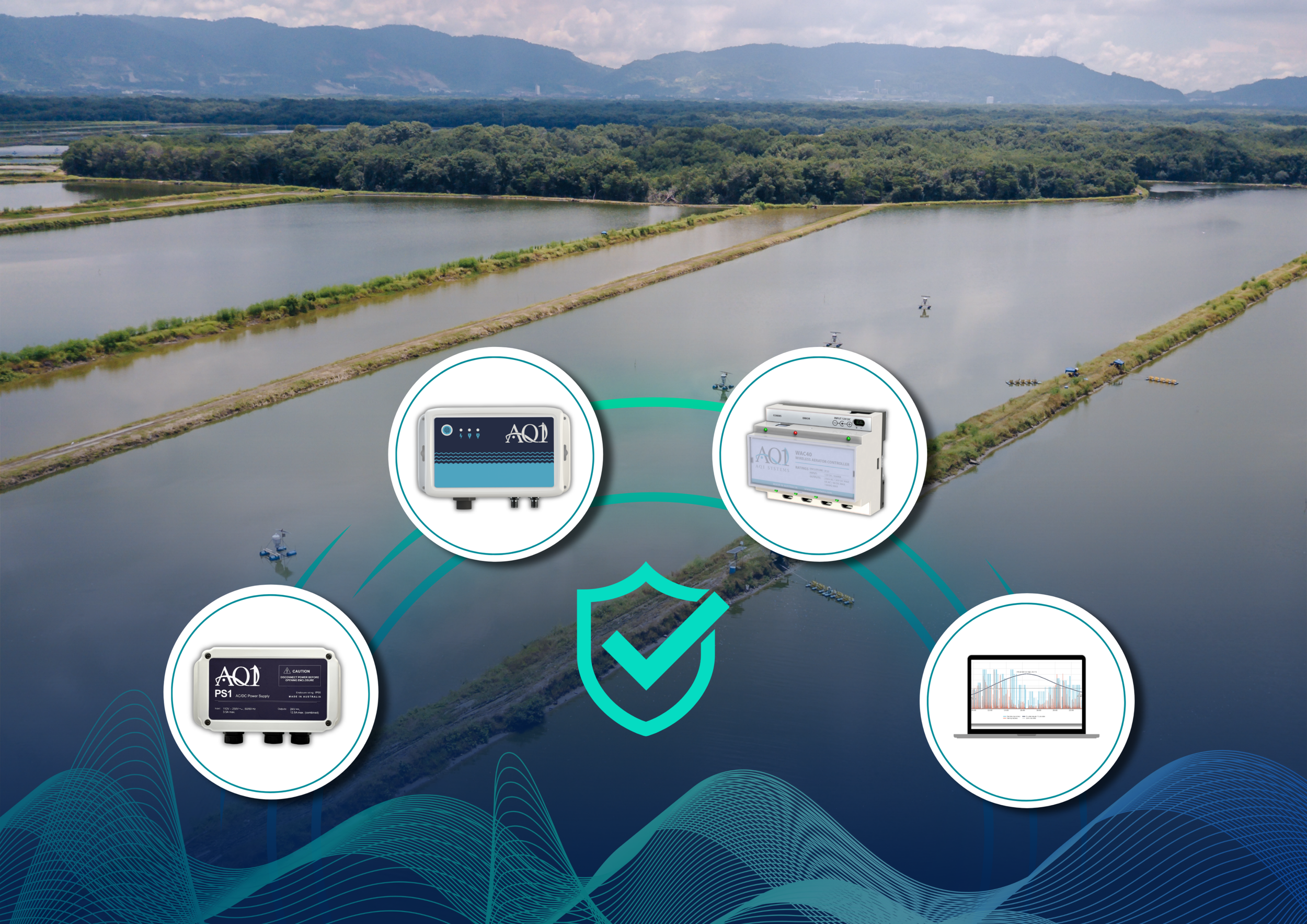
Oxygen and temperature sensors should connect to both feeding and aeration, and be simple to maintain and recalibrate, including for salinity after heavy rain, so readings stay accurate when they matter most. The SE1 Smart Enviro Station, new in SONIC 26.10, supports self-cleaning sensors, which cuts routine maintenance and keeps readings accurate between visits.
3. Aeration on schedule, on oxygen, or both
Some aerators should run to a set programme while others stand by as backup, triggered when oxygen falls below a threshold. The farmer sets that threshold, because they understand their farm. The Wireless Aeration Controller (WAC) can now combine both in the same day, for example running on a timer through the day and on oxygen overnight, when the pre-dawn low arrives. Aerators that switch on when they are needed, and off when they are not, also save power.
4. Data that goes where you need it
Clear alarms when conditions change, and data that flows into the farm's own reporting tools, including a record of what changed and when. New API endpoints in SONIC 26.10 show who changed a meal schedule and when, and DOSat is available through the API and Data Download.
5. A closed loop you can trust
Control should sit pond-side and not depend on the cloud. As long as the controller has power, feeding and aeration keep working, whatever happens to the internet connection. PS1 External Power Supply, also new in SONIC 26.10, gives AQ1 field devices a stable power supply, and if communication fails, WAC switches the aerators on.
Letting farmers farm
The test of all this is simple. Does it let the farm team concentrate on production? Too often, the questions on a farm are different. Is that aerator on? Has anyone changed the feed rate for the rain? Who changed the schedule? The questions that matter should be:
• Are my shrimp growing to target?
• Are they eating what their biomass needs?
• Is feed turning into growth?
• Are my shrimp healthy?
• Are my water conditions good, and what needs to change?
A well-integrated system handles the routine work itself and brings the rest to the farmer's attention. As growth potential rises and the environment gets less predictable, that is what more adaptive and more productive means on the farm.
And the question farmers should not have to ask: did the aerators come on last night?
Diagram 1: 24-hour dissolved oxygen curve overlaid with 24-hour feeding activity. Show afternoon supersaturation from algal photosynthesis, the pre-dawn oxygen low, and reduced feeding at both extremes
Frequently Asked Questions
-
SONIC 26.10 is focused on helping farms operate more adaptively as pond conditions change. The release adds DO % saturation (DOSat) in AQ1 Analytics, greater visibility of Feeding Strategy changes, new API data, and support for new AQ1 field devices including the SE1 Smart Enviro Station and PS1 External Power Supply. It also expands Wireless Aeration Controller functionality so aeration can combine scheduled and oxygen-triggered operation.
-
El Niño can bring heavier rain, warmer water and sudden changes in salinity, adding pressure to already nutrient-rich, high-production ponds. These changing conditions can contribute to algal blooms and greater fluctuations in oxygen, including high oxygen saturation in the afternoon and low oxygen before dawn.
For shrimp, that matters because feeding behaviour changes with pond conditions. Shrimp may eat less when oxygen is low and also during supersaturation. Feeding at the wrong time can mean wasted feed, adding even more nutrient load to the pond.
The result: a less predictable pond and a finer margin for error.
-
SONIC 26.10 helps farmers adapt feeding and pond management as conditions change.
AQ1 sonic feeding responds to how shrimp are actually eating, while SONIC 26.10 adds greater visibility of pond conditions through DO % saturation (DOSat) alongside oxygen in mg/L and temperature. Aeration can also combine scheduled operation with oxygen-triggered control, helping the farm respond when oxygen conditions change.
SONIC 26.10 also records Feeding Strategy changes, helping farmers see when feeding has been adjusted for conditions such as rain or low oxygen.
-
When pond conditions become more variable, the opportunity is to use feed, aeration and farm resources more efficiently.
AQ1 sonic feeding adjusts feed according to shrimp feeding activity, helping address the risk of continuing to offer feed when shrimp are eating less. Aeration can combine scheduled and oxygen-triggered operation, allowing aerators to switch on when needed and off when not needed, which Keone Dodd notes can save power.
The new SE1 Smart Enviro Station also supports self-cleaning sensors to reduce routine maintenance and help maintain accurate readings between visits.
-
Farmers interested in updating to SONIC 26.10 should contact their local AQ1 Service Team.
Other Articles & Expert Insights
From Seeing More to Managing Smarter
SONIC 26.06 strengthens AQ1 sonic feeding ecosystem by delivering integrated improvements across feeders, hydrophones, sensors, and AQ1 Analytics. Designed for large-scale shrimp farming operations, this release helps ...
15/06/2026
Unlocking the Value of Multiple Feeding Zones
At AQ1, innovation begins with listening. Our journey to multi-zone feeding has been shaped by years of listening - to shrimp, to farmers, and to the realities of pond dynamics. Increasing the number of feeding zones unlocks a new level of…
15/10/2025

Our Technology
About us
Legal
Contact us